
 Español
 Pусский
 Français
 العربية


folding endurance tester
A folding endurance tester is a precision instrument used to evaluate the ability of paper, cardboard, film, textiles, and other flexible materials to withstand repeated bending or folding without breaking, cracking, or losing structural integrity. It is an important device in quality control, product development, and material research because many products are expected to endure repeated mechanical stress during handling, transportation, and actual use. By simulating continuous folding action under controlled conditions, the tester provides an objective measurement of durability and fatigue resistance.The basic principle of a folding endurance tester is straightforward. A specimen is clamped into the machine and subjected to repeated folding cycles at a specified angle, tension, and speed. The machine continues the test until the sample fails or reaches a predetermined number of cycles. The result is typically expressed as the number of folds the material can survive before rupture or visible damage occurs. This value helps users compare different materials, coatings, thicknesses, or processing methods.A standard folding endurance tester usually consists of a sample clamping mechanism, a folding arm or blade, a drive system, a counting unit, and a control panel. The clamping system holds the specimen firmly to ensure consistent test conditions. The folding mechanism moves back and forth to bend the sample repeatedly at the same point. The counter records the number of cycles automatically, allowing accurate and repeatable results. Many modern instruments also include digital displays, programmable test settings, and automatic stop functions when the sample breaks.This instrument is widely used in industries where material flexibility and durability are critical. In the paper industry, it helps determine the folding strength of writing paper, packaging paper, and special papers. In the textile field, it is useful for evaluating the fatigue resistance of fabrics, coated materials, and nonwovens. In packaging and printing applications, the tester can assess whether folded products will resist cracking or delamination during use. It is also applied in laboratories studying the effects of humidity, fiber composition, surface treatment, and manufacturing processes on endurance performance.The advantages of a folding endurance tester include high accuracy, simple operation, and strong repeatability. Because the test conditions are standardized, the results can be compared across batches and materials. This makes it easier to identify quality variations and improve product design. Some advanced models offer adjustable folding angles, test speeds, and tension levels, making them suitable for a broader range of materials and testing requirements.In practical use, specimen preparation is very important. The sample should be cut to the correct size, conditioned under appropriate environmental conditions, and mounted properly to avoid errors. Since factors such as temperature, moisture content, and fiber orientation can influence test results, consistent procedures are essential for reliable data.Overall, a folding endurance tester is a valuable tool for measuring the repeated-folding durability of flexible materials. It supports quality assurance, product optimization, and research by providing clear and reproducible information about material performance under mechanical stress.
Products
Category:
-
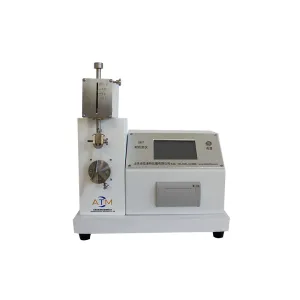
Automatic Folding Endurance Tester
Category: Paper Testing InstrumentsBrowse number: 178Number:Release time: 2026-08-11 09:09:31The Automatic Folding Endurance Tester is an upgraded version of the AT-NZ-1, designed and manufactured in accordance with the national standard GB/T 457-2008 (Paper and board — Determination of folding endurance). It is specifically used for testing the folding endurance of paper and paperboard. The instrument features an imported servo motor with direct drive, completing the 135±2° folding angle conversion directly on the motor shaft, thereby eliminating the noise and wear issues associated with traditional mechanical conversion methods. The folding speed is settable at 175±10 folds/min, the folding head width is 19±1mm, and the fold radius is 0.38±0.02mm. The spring tension is adjustable from 4.91 to 14.72N, with fold gap distances selectable from 0.25-1.00mm. The measuring range is 0-99999 folds. The instrument is equipped with a touchscreen control system and Annimet testing control software V1.0, supporting tabular data processing with automatic calculation of maximum, minimum, average, and coefficient of variation, along with force-displacement and force-time curve displays. Photoelectric control technology ensures the folding clamp automatically returns to its initial position after each test. A built-in micro-printer is standard, with optional WIFI/USB/remote transmission. Overall dimensions are 380×280×430mm. This instrument is commonly used in paper mills, box plants, research institutes, and universities.
News
Category:
No search results found!
Case
Category:
No search results found!
Video
Category:
No search results found!
Download
Category:
No search results found!
Job
Category:
No search results found!
Featured Products
No search results found!



 Phone
Phone