
 Español
 Pусский
 Français
 العربية


brightness colorimeter
A brightness colorimeter is a precision instrument used to measure the brightness and color characteristics of a surface, material, or light source. It plays an important role in quality control, scientific research, manufacturing, and product development. By providing objective numerical data, it helps users evaluate whether a product meets specific visual and color standards. Unlike subjective visual inspection, a brightness colorimeter offers consistent and repeatable results, which makes it valuable in industries where appearance and color accuracy are important.The main function of a brightness colorimeter is to detect and analyze the light reflected or emitted by an object. It can measure parameters such as brightness, chromaticity, color difference, and sometimes whiteness or yellowness, depending on the model and application. The device usually works by shining a controlled light source onto the sample and then measuring the reflected light with highly sensitive sensors. These sensors convert optical signals into digital values that can be displayed on a screen or transferred to a computer for further analysis.Brightness colorimeters are widely used in many fields. In the paint and coating industry, they are used to ensure that colors match design requirements and remain stable across batches. In printing, they help maintain accurate color reproduction on paper and packaging materials. In textiles, they are used to check color consistency and the appearance of dyed fabrics. In plastics, ceramics, food packaging, and building materials, they help verify surface brightness and color uniformity. They are also useful in laboratories and educational settings for studying optical properties and color science.One of the key advantages of a brightness colorimeter is efficiency. It can complete measurements quickly, saving time during production and inspection. It also reduces human error and improves standardization. Many modern devices are compact, portable, and easy to operate, allowing users to take measurements directly at the production site or in the field. Some models include built-in memory, data export functions, and software support for tracking results over time. This makes it easier to compare samples, monitor changes, and maintain consistent quality control.A brightness colorimeter typically features a measurement aperture, display screen, calibration system, and internal processing unit. Before use, the device is usually calibrated with a standard reference to ensure accuracy. Users place the sample under the measuring head, and the instrument immediately provides the required color and brightness values. Proper calibration and careful handling are important to achieve reliable results.In conclusion, a brightness colorimeter is a practical and essential tool for measuring visual properties with accuracy and consistency. It supports product quality, process control, and research by turning color and brightness into measurable data. As technology continues to improve, brightness colorimeters are becoming more accurate, easier to use, and more widely applied in modern industries.
Products
Category:
-
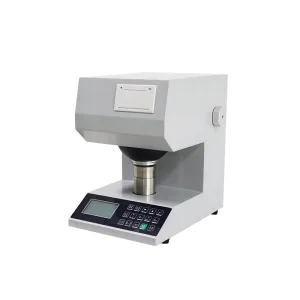
Whiteness and Color Tester
Category: Tissue & Hygiene Product Testing InstrumentsBrowse number: 216Number:Release time: 2026-07-21 11:45:55The Whiteness and Color Tester is a multi-functional optical property testing instrument widely used in industries such as papermaking, printing, textile dyeing, ceramics, building materials, chemicals, grain, and salt production. It measures blue-light whiteness, Hunter whiteness, yellowness, color, and color difference, as well as paper opacity, transparency, light scattering coefficient, light absorption coefficient, and ink absorption value. The instrument uses a simulated D65 illuminant and d/o illumination viewing geometry (integrating sphere diameter 150mm, measurement port diameter 25mm) with a built-in light absorber to eliminate specular reflection effects. It adopts the CIE 1964 supplementary colorimetric system and CIE 1976 (L*a*b*) color space formula. Measurement repeatability is ≤0.10 with high accuracy. The instrument stores up to 10 reference sample values in non-volatile memory, supports digital display and report printing. Compliant with dozens of national and international standards including GB/T 7973, GB/T 7974, ISO 2470, and ISO 2471, it is the standardized instrument for whiteness and color testing across multiple industries.
News
Category:
No search results found!
Case
Category:
No search results found!
Video
Category:
No search results found!
Download
Category:
No search results found!
Job
Category:
No search results found!
Featured Products
No search results found!



 Phone
Phone